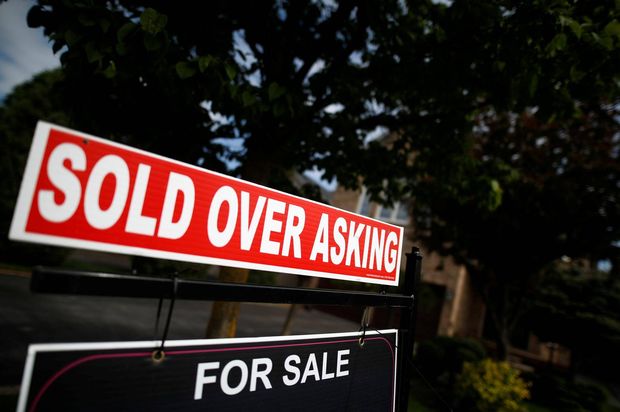
Showing posts with label Mortgage. Show all posts

Thursday, 27 January 2022

What does rising interest rates mean for homeowners?


    While I found it surprising that the Bank of Canada decided to keep rates steady yesterday (Jan 26th 22), especially in light of sustained inflation above their mandated target. 

    That being said, I also recognize that the Bank of Canada is between a rock and a hard place. On one hand, they have their mandate to maintain inflation between 1 and 3% (targeting 2%). On the other hand, Canadians have been amassing serious levels of debt, with some of the latest estimates pegging Canadian debt to disposable income at just over 177%.

    That is, Canadians tend to owe $1.77 for every dollar of income they earn -- but why does this cause trouble for the Bank of Canada?

    Well, as the Bank of Canada increases the overnight rate to combat inflation, this will also increase debt servicing costs for many Canadians, increasing the proportion of their income that goes towards interest costs. Depending on how rapidly the Bank of Canada acts - this could push certain Canadians into insolvency 

    According to an Ipsos survey from 2019, almost half of Canadians are $200 or less away from insolvency. One can imagine that since the pandemic, and increasing prices all around, this outlook has not improved. 

    Now, with the picture painted that Canadians are heavily indebted, with many on the verge of financial ruin - let's look at the housing market - That is, if the Bank of Canada were to increase interest rates, what impact will this have on the mortgage payments being made by Canadians? 

    First, important to differentiate between variable and fixed-rate mortgages. 

    Variable-rate mortgages are linked - somewhat - to the Bank of Canada's overnight rate. Speaking in generalities, if the Bank of Canada increases the overnight rate by 25 bps, then the variable rate mortgage also increases by 25bps -- meaning the debtor's payment will have to increase.

    Fixed-rate mortgages are a little different - with a fixed rate, the debtor is locked into a given rate for a certain term (say 5 years). With this arrangement, the debtor's payments are constant over the term of the mortgage but will be re-negotiated upon renewal (typically every 5 years).  That is, an increase in interest rates today will have no impact on the holder of a fixed-rate mortgage - until renewal.

    That is to say, a change in the overnight rate will impact variable rate holders immediately, but will impact fixed-rate holders over time - as they renew at new, potentially, higher rates.

    So let's see what the impact on monthly mortgage payments would be if we received a 100bps increase in interest rates (a conservative forecast).

    To do so, let's begin by determining the monthly payment on mortgages of various amounts if the current mortgage rate is 2.5% (a typical fixed-rate amount). 


    While not interesting on its own, let's re-work out what the monthly payment would be at a rate of 3.5%


    Here we see an increase in monthly payments, but what is the magnitude change in monthly payments?


    Thus we see that an increase of interest rates (from emergency lows) by 100bps, which still leaves at historic lows, causes drastic increases in the monthly mortgage payment for many Canadians. 

    Given, as we saw, that many Canadians are within $200 of insolvency we can now see why the Bank of Canada may be so hesitant to begin rapidly increasing interest rates. Even with this - this is just looking at the impact on mortgage payments, many will also be witnessing a potential increase in car loans, student loans, line of credit, etc. All together causing potential trouble for many Canadians.

    Of course - all this assumes that these payments (and prices) are rising, but incomes are staying constant - Of course, this is not true, as we witness inflation, there should also be increased pressure for wages to rise offsetting some of this pain - Although, we just showed a 100 bps increase in the lending rate would cause an 11.5% increase in monthly payments, unlikely that incomes will increase that much.

    Feel free to comment below with your thoughts 

Tuesday, 2 July 2019

"Housing Should be Affordable"


This is an interesting opinion piece from the CEO of the Canadian Mortgage and Corporation (CHMC)

As the title sums up, housing should be affordable.

Clearly a normative statement, but just the same, there is definitely a general social belief that everyone ought to be able to afford or have access to shelter. The question then is what should the price of shelter be?

As any first-year Econ student can show, the price of a good will be determined through its supply and demand. As Mr.Siddal outlines in his article, over the last several years demand for housing has gradually increased due to factors such as population growth, speculation, access to cheap credit, etc. while supply has remained relatively constant due to restrictive zoning.

Mr. Siddal discusses many of the current initiatives to ease affordability and rightfully critiques many of them stating that they simply further encourage demand by allowing greater access to the market.

Despite this rising demand pushing up prices, the supply has maintained relatively constant (unlike the picture above, that is, vertical in the short-run). This has simply resulted in inflating prices creating one of the greatest creations of wealth in generations (For the generations who were already owners).

I recently had a very good question in regards to this from a student who stated (Paraphrased).
House production appears to be perfectly competitive, or nearly so. There are many builders. Despite differentiated housing, many are at the point where they will accept any shelter - thus the consumer views the good as fairly homogenous (same). Shouldn't this price increase cause enourmous positive profits to builders and developers causing more to enter, increasing supply and bringing the price back down to a zero profit level?
While I tend to agree with the statement, there are some serious issues to this. It is primarily (at least here in coastal BC) the land, not necessarily the buildings which have increased in price - Can't supply more land. Thus the solution would be:

  1. More Sprawl - frowned upon with increasing traffic congestion, gas prices and known environmental/health impacts. 
  2. Densification - more units per space of land, thus keeping the cost per unit down. 
While densification seems like a great solution, it runs into many hurdles such as zoning restrictions and existing residents opposing any development due to the potential of "Changing the nature of the neighborhood". Thus at the municipal level, densification and revision of zoning bylaws have been a large barrier preventing new developments and thus preventing an increased supply of shelter. 

What should be done then? 

This is clearly a difficult question. As Mr.Siddal states, housing should be affordable. The problem with this statement, however, is "at what price is housing affordable?" how do we determine what this price is? and even if we do determine some price, what makes that price affordable? 

Let's assume for a second that we do (somehow) known what an affordable price is. How do we go about achieving such a price?

Restrict Demand? Doing so would cause the demand to shift left, lowering the price. But how does one go about restricting the demand for housing? Furthermore, if you restrict demand by placing tougher stress tests on qualifications, or placing higher taxes on property transfers ... doesn't this in fact just inhibit affordability? 

What if we just restrict demand to limit "Speculators". This is what we are seeing right now in the most populous parts of BC with the "Speculation tax". If you follow the news, this is very unpopular amongst many people with comments typically being along these lines:
  • We have had a family vacation home in [city] for generations, now I have to pay an extra [$tax] in order to keep this. We spend [X weeks] in this community every year contributing to the local economy, now we won't be! 
  • I bought a home in [city] as part of my retirement plan. now with this extra [$tax], I won't be able to afford to retire.
That is, families and individuals who are owning second properties for recreation or investment have been labeled as speculators. I have written about this previously, commenting that this should be a vacant homes tax, not a speculation tax - thus being clear that it is to encourage the use of housing as shelter, not simply as a tax on speculation. But just the same the imposition of this tax has alienated a generation who could afford more than one residence and had done so for either recreation or retirement planning purposes. 

Restriction of demand then seems to be politically unpopular amongst those restricted (we will see how it pans out with voters). 

This then leaves expansion of supply? Causing a shift of the supply curve to the right, which would similarly cause a reduction of price. 

How do we go about this? A few ideas are offered such as:
  • Easing of zoning bylaws to encourage more development.
    • Will fundamentally 'Change the nature' of neighborhoods which has proven to be unpopular with existing residents (NIMBY)
  • Engage in a large publically funded and owned building strategy.
    • This kicks up many more questions such as "where?" again NIMBY. As well as brings up many memories of "The Projects" amongst many other public housing developments. 
That is the problem with increasing supply seems to be that there is not the will to have this happen. It is a great idea, as long as it happens somewhere else. Hence the problem. 

Suppose we overcome the NIMBYism (some evidence that some municipal governments are making progress on this) which stimulates an increase in supply and allows prices to come down. This leads to a second question which is one many don't actually want to ask. "Do we want housing to be affordable" That is, do we want prices to fall to a point such that people can afford shelter?

A recent report (news article here) highlighted that current prices would need to be cut in half for millennials to be able to afford to buy. 

Thus, if we want affordability (let's assume this definition of affordability for a minute) do we actually want prices to fall by 50%?

Given many factors, the answer to this is likely no. Many Canadians who own their house have used their home as their primary investment vehicle for retirement. This now throws the retirement of many into jeopardy. 

Similarly, if we look at the household indebtedness of Canadians we find it is quite high with a big proportion of this being mortgage debt. For these Canadians, a severe price increase would put them in a precarious, if not negative equity situation. Similarly, a big problem impacting the wealth and equity of a large swath of Canadians. 

To conclude. Yes, few would argue with the statement that housing should be affordable. the issue with this, however, is that any action to make housing affordable is politically unpopular as the result is the erosion of wealth and equity from current owners in order to allow sustained entry to future owners. 

The real solution, if possible, would be some solution that does not result in a zero-sum outcome. That is a solution which allows current owners to maintain their equity while allowing new entrants affordable options. 

What are your thoughts? feel free to comment below.


Thursday, 12 July 2018

The Impact of Changing House Prices on GDP in BC

Source: https://www.armstrongeconomics.com/markets-by-sector/real_estate/real-estate-in-decline/
Yesterday (11th of July 2018) the Bank of Canada continued to increase interest rates, as many expected. 

Since the increase in the interest rate, the media coverage has been flooded with conversation around the impact this will have on homeowners. Specifically, it is well presented that Canadian households currently have a pile of debt and will have trouble continuing to service their debt if their payments or obligations increased. you can read a Bank of Canada article on the subject here.

Building off of these discussions, although quite separate, I began to wonder. Here in BC the Finance, Insurance and Real Estate (FIRE) industry make up essentially 25% of our provincial GDP.

As governments continue to engage in policies which aim to make housing more affordable (decrease or slow price growth) and as the Bank of Canada continues its upward movement of interest rates (decreasing the demand and supply of real estate); we have some serious headwinds on house price growth. The question of interest then: Given the size of the FIRE industry in BC, for some change in the house price, how does this filter through to impact our provincial level of output?

To answer this I conducted a simple time-series analysis which allowed me to jointly model both house prices (Teranet national bank composite house price index for BC) as well as the provincial GDP (Statistics Canada).

In order to ensure stationarity, these variables have a log-difference transformation applied to them, giving them the interpretation of the annual percent change. Each can be viewed independently below:


With these variables, I then apply a one standard deviation shock to the transformed House Price Index (HPI), which works out to be about a 4.6% point annual change in the index. Observing how this shock filters itself through both the HPI and GDP over time we see the impact of this shock. This impact is presented below.


First, evaluating the impact of a 4.6 percentage point shock to the House Price Index (HPI) on itself. What we witness is no big surprise, the housing price index jumps in the shocked year (year 1) and then slowly returns to it's normal. With a 95% Confidence level, this shock to house prices has been fully absorbed within 2 and a half years.

Recall we are dealing with growth rates here. Imagine the HPI is doing its thing, then, out of the blue, it jumps by 4.6 percentage points. the effect is an immediate increase in the index, followed by 2 and a half years of additional (but slowing) growth before returning to its pre-shock level of growth. 


Looking at the impact of a shock to the HPI on GDP we witness an impact which was expected. Our shock happens in year one, however, this does not filter through to impact our level of GDP until the second year. At this point, the GDP jumps to an estimated increase of 2 percentage points (fairly large given average growth rates of GDP). However, this impact quickly subsides and is showing no statistical effect 2 and a half years after the shock.

Through this, we can determine the elasticity of GDP to the HPI (for some % change in HPI, what is the impact on the % change in GDP). Thus we can determine the elasticity of GDP to be 0.435, meaning that GDP is not overly sensitive to a change in the HPI, that is GDP would be inelastic. Just the same we can take this to mean that for a 1% point change in the HPI, we would expect to witness a 0.435% point change in the GDP.

So, if we do see a collapse of house prices, this may filter into a bad few years for the BC Economy. Keep in mind, in 2014 when oil prices collapsed causing Alberta's GDP to collapse, Oil and Gas (with support services) accounted for aproximately 8% of Alberta's GDP. Given BC's reliance on the FIRE industry (25% of GDP), a collapse in the price of real estate could very well have a major impact on our provincial economy.

What are your thoughts on this, feel free to comment below.

Saturday, 24 February 2018

BC Budget - Housing

Source: https://www.facebook.com/homeiswhereitstarts/

As expected one of the big highlights of the recent BC Budget (yet to be passed in the legislature) is the focus on implementing new policies in order to deal with the housing affordability issues we have seen in BC over the last decade.

The full BC Budget can be found here, the highlights here, and finally the focus on the housing action plan here.

First some praises for the plan.

The plan, although not perfect, aims to deal with both demand and supply side problems currently being faced by the real-estate market. With these policies being aimed to cool demand and stimulate supply (Contrast this to previous policies such as 0% downpayment loans to help first time home buyers. A policy which further stimulated demand).

On the Demand side:

  • Introduction of a speculation tax.
  • Increasing the foreign buyers' tax from 15% to 20% and expanding this tax out of Metro Vancouver to include the Fraser Valley, CRD, and Okanagan.
  • Increasing property taxes (school tax rate) for properties over $3 million. 
  • Actions to prevent speculation and pre-sale condo re-assignments. 
On the Supply Side:
  • Government $6 billion dollar investment in affordable housing
    • 14,000 rental units for 'middle' working families.
    • increasing student residences at universities and colleges.
    • Providing changes to property taxes to encourage rentals. 
What does all this mean? Let's start working on the demand side followed by the supply. 

First the speculation tax, other than the announcement of the idea of a speculation tax, we know very little as to what this would entail, as a result, it is difficult to say what effect this may actually have on the market. Just the same, I am under the belief (normatively) that if effectively placed could have a significant impact on cooling the market. I have written several times on the role of speculation in the housing market, starting with this article here.

Second the Foreign Buyers Tax. I have written about this before as well. to be brief - I am not a fan of this policy. To read my reasons why you can find the previous post here.

Increasing property transfer taxes and school rate taxes for properties over $3 million: There is a part of this policy which seems satisfying. Ratchet up the taxes for those rich enough to afford a $3 million mansion, but keep in mind, many of the people who have found themselves owning multi-million dollar properties are seniors, on fixed incomes who have just always lived in their house and seen property values rise exponentially around them! 

I have witnessed several sad experiences where seniors have come into the bank, they had bought their property decades ago, out in the boonies, only to find that now their property has exploded in value, with the property taxes being so high that they can no longer afford to pay them through any method other than a reverse mortgage, or city lien on their property. 

Finally, actions to prevent speculative pre-sale re-assignments of condos. Again my belief is that this could be an effective policy, as with the speculation tax, however, the big question I have is what does this look like and how will it be enforced. 

To the supply side: 

A $6 billion dollar investment over the next ten years. Let me start by saying that a minority government releasing a spending plan over the next ten years is rather wishful and thus leaves me skeptical. 

I am not sure of the exact details or conditions of this $6 billion, so let's assume this money is available as financing, and funding for public institutions to increase rental housing and student residences. 

First, building 14,000 rental units for the 'middle'. This may be a great idea, but ultimately I feel it will fall into the slow molasses of municipality zoning and bylaw processes which many have argued to be the primary supply problem contributing to the current affordability crunch. Thus I am interested to see how this materializes.

If this does materialize and if this materializes as 14,000 new rental units, not just "14,000 rental units over the next 10 years" then this may have an effect of driving down rents in areas like the CRD and Metro Vancouver where rental affordability remains just as much of an issue as purchasing a home (near 0% vacancy rates in both regions). 

An increase in investment for student housing will also help to relieve the pressure on rental markets (again primarily in university towns such as Nanaimo, CRD, Lower Mainland and the Okanagan) by allowing students their own specific residence it frees up more rental units for the rest of the population, thus allowing an increasing vacancy rate and decreasing price pressure for rents. 

In conclusion, there are still a lot of unknowns with this housing action plan, but preliminary evaluation looks promising to slow (or temporarily) reverse the acceleration of home and rental prices through policies aimed at cooling the demand while stimulating the supply. 

In the coming weeks, I am sure the specifics of these policies will be revealed. Given the nature of politics, come that time I may have to retract the optimistic tone I have. 

What are your thoughts on this policy?  I have taken a rather one-sided approach in my discussion above, but all policies are going to have both winners and losers. Think about who the losers are following the imposition of these policies and what this means for them. 

Feel free to comment below. 

Friday, 1 December 2017

Almost Half of Canadian mortgages up for renewal next year.

Bank of Canada has recently released a report on Canada's financial system and the risks presented to it. the full report can be found here.

Although there was a lot of interesting insight into the Canadian mortgage and debt situation of Canadians, the part which really stuck out to me was that 47% of Canadians are set to renew their mortgages within the next year. Expanding this out, 78% of Canadians will be renewing sometime between now and 2020.

On this there has been a lot of talk of the renewal shock, shouldn't be a surprise that interest rates have been creeping up over the last year. Thus at first glance, I bought the whole renewal shock argument.

I then started thinking back to about 5 years ago when I was underwriting 5 year fixed rate mortgages typically at about 2.99%. Fast forward to today and the local bank is advertising 5 year fixed rates of 2.84%, jumping on to "ratehub.ca" shows an even lower 5 year fixed rate of 2.69% currently.

Although I don't recall giving out many rates lower than 2.99% looking back at ratehub.ca - it appears that during the spring early summer of 2013 rates fell to a low of 2.64% before rising to a high of 3.68% (I do remember when this spike happened).

The end result is that through most of 2013 rates were on par or higher than rates are today. Taking a ceteris paribus approach that today's 5-year fixed rate will more or less stay constant through 2018 means that the 47% of Canadians renewing this year will be renewing at a similar if not lower rate than their current mortgage contract.

It is not until about the end of 2014, early 2015 that the 5-year rate dipped below current rates. That is if rates were just to stay constant, those renewing in 2019 and 2020 will likely see a higher rate on their renewal than they had on their previous contract. likely this will not be a problem though as these families have also likely seen their incomes grow over this time period.

All this to say, Although it is interesting that we have such a huge bulk of mortgages entering renewal in the next year, it may be much ado about nothing. likely many of these households will be renewing at contract rates similar to their previous, and thus unlikely to see a payment shock.

The potential problem that may arise - often renewals provided the financial institution with the time to re-visit clients finances, allowing the opportunity to up and cross-sell products or consolidate debt into the mortgage (push a 20-year term back out to 25 for example).

While the new rules coming into effect are not going to affect renewals - they will end up affecting any mortgage which is re-written. this means it will greatly inhibit the financial institution's ability to rework clients debt, or for clients to consolidate larger consumer debt into their house.

What are your thoughts on this report?

Is it that this massive 47% of mortgages coming up for renewal over the year is a cause for concern or just business as usual?

Feel free to comment below.


Thursday, 23 November 2017

Canadians most indebted in OECD

Canadian households borrow more as a percentage of the size of the economy than anyone else in the world does, the OECD says in a new report.


Stumbled across this CBC Article today, you can find the full article here

I have written and spoken on much of this before, but a brief summary is that Canadians currently are the most indebted of any OECD nation with 101% household debt to GDP. with the link being made that the majority of this debt is being held in real-estate or mortgage debt.

I know the Bank Of Canada has expressed concern about this the last few times they have raised rates to control inflation.

Reason being, here in Canada, majority of mortgage holders are on five year fixed rate mortgages. That is, every five years they need to re-negotiate their mortgage rate with their financial institution. So any borrower who locked in 4 years ago at record low rates, now that they are coming up for renewal, they may be in for a surprise as their mortgage payments drastically increase in order to keep their amortization schedule on track.

If inflation ever rebounds forcing the Bank of Canada to act on interest rate to fulfill their mandate ... many borrowers may find themselves in trouble.

Adding to the problem, the article also notes that house prices in Canada are 50% over-valued in relation to the corresponding rental price for that real-estate. Although there are several ways in which rental prices are tied to real-estate price, if you are interested about the relationship, I have written about one here.

What are your thoughts on the revelation, shocking, or as expected?

Feel free to comment below.


Wednesday, 31 May 2017

The IMF on Canada's Housing Market

Image Source: Curry, Bill. Globe and Mail, "IMF warns of significant risks from Canada's housing market",https://beta.theglobeandmail.com/report-on-business/economy/imf-praises-infrastructure-bank-plan-flags-housing-market-concerns/article35160977/?ref=https://www.theglobeandmail.com&service=mobile
Recently came across this article in the globe and mail, the full article can be found here. It seems that once again the IMF is warning Canada that our housing market is overheated and that this may have serious consequences for future economic performance.

Here the IMF notes how the Canadian banks credit ratings were recently downgraded expressing fears over the number of consumer loans and mortgages on their books and the potential risk that they present given the exceptionally high levels of consumer debt.

I was happy to see this little bit in the report:
Ms. Lim's staff statement also took issue with the foreign buyers tax approach introduced in British Columbia and Ontario that "discriminates against non-resident buyers." The IMF states that non-resident activity is not the sole driver of housing prices and the provinces should replace the foreign-buyers taxes with more effective tax changes aimed at discouraging speculative activity.
Where the emphasis is my own.

What are your thoughts on this? Are we heading for a correction? Or, alternatively, is there too much on the line for the government to allow a housing correction to actually happen? If that is the case, can we have this hypothesized 'soft landing'?

feel free to comment below.

Tuesday, 14 March 2017

Calls for extending the foreign home buyer tax

Image source: http://vancouver.ca/about-vancouver.aspx
If you have been watching the news, there have been recent calls to extend the Vancouver foreign home buyer tax (a 15% tax levied on foreign buyers of real-estate) from Vancouver to Toronto and Victoria as well.

some of these news articles can be found here, here, and here.

What I find amazing about these arguments for a foreign homebuyer tax is the covert racism that underpins it. That somehow, only foreigners are able to afford homes in such quantities that it stimulates demand and pushes up prices!

Specifically, (in my opinion at least) the problem is not foreigners willing to pay obscene amounts for homes - if they plan to reside in said homes. Rather, the problem becomes when individuals (whether domestic or foreign) are willing to pay obscene amounts for these homes because they view these as an investment rather than a form of shelter.

Let's compare and contrast two similar and current situations.

First, Imagine if you will, an individual from China decides to move to Vancouver and purchased a  $1 million dollar condo to live in, paying a $150,000 tax because they are not a Canadian citizen or permanent resident. However, this individual has planned to live in this home - maybe attending school, working, or starting their own business, all in Canada and contributing to local economy.

Meanwhile to contrast.

Second, a Canadian investor from elsewhere in Canada buys a condo in Vancouver for $1 million. Because this investor is domestic, he (she) pays no foreign homebuyer tax. At the same time, this investor is not residing in the condo, nor are they renting it out, as they are betting on the market appreciating and earning capital gains through this price appreciation.

What is the difference between these two cases?

In both cases, there was a new purchase of real-estate, adding to the demand for real estate in Vancouver.

the difference rests in what is done with that purchased real-estate.

In the first case, the foreign national has purchased the condo to live in, using it as shelter, thus jointly adding to the local economy, spending their money and spurring economic activity. (even if they are also hoping to sell in a few years for capital gains!).

In the second case, the domestic investor has purchased the condo to sit empty. thus adding to the demand for real-estate, but other than the initial contribution to the FIRE (Finance, Insurance, Real Estate) industry, there is no prolonged contribution to the local economy.

The question then - which scenario is more damaging?

Well, if real estate is viewed as just another good, then neither case is overly damaging, as in both cases both the buyer and seller are obtaining value from their transaction - which is why they transact!

However, if real estate is understood to be the primary form of shelter (a basic human need) then the second case clearly carries more social costs (increased demand pushing up the price while excluding others the use of the shelter.).

While the first case also adds to the demand, pushing up the price and excluding others the use of the shelter - we are also experiencing a continued contribution to our economy, through an addition to the labour force, additional consumer spending, and possibly investment, all of which helps spur the economy which may not happen in the pure real estate investment situation.

To wrap up, my personal feeling, and opinion. Is that there is a problem with the current real estate market, but that foreign buyers are not in themselves the problem, but rather an easy target. The problem lies in the use of real estate as an investment - something to be bought to earn a return rather than something to be used as a shelter. In this case, it is not that foreigners are the problem, but real estate investors in general, whether they be domestic or foreign.

Thus a foreign homebuyer tax is discriminatory, and perhaps even violates trade agreements which require laws to be enacted fairly over both domestic and foreign individuals and companies. Specifically, what should be evaluated is a changing tax structure to penalize real estate speculation in general, regardless of ethnicity - however, this is clearly easier said than done!

What are your thoughts on this? feel free to comment below.

EDIT: I want to clarify, real-estate investment in terms of a rental property is not really an issue in my mind and in fact should probably be encouraged. The issue becomes real estate investment in vacant properties for capital gains and given the recent census and many investigative news pieces, this appears to be a growing problem.

Tuesday, 28 February 2017

Present Value of shelter -- part 2

Image Source: https://clipartfest.com/download/c4caaa1fc43167db76f3e9cf0206708647023d40.html

Here is part two of a post that aims to evaluate housing as an investment ... where owners are expecting to earn an annual return (rent) as well as capital gains due to appreciating property values upon final sale.

in part 1 - I laid the groundwork as to the basic premise which would be used to evaluate the prices of real-estate.

recall -- that basically, the most a rational investor would be willing to pay for an investment is the present value of the income stream of the investment, with all future income being discounted by a corresponding equivalently risked market return. for a re-hash as to what this looks like, part 1 can be found here.

In this, we have to lay some basic assumptions out first.

  • housing in Victoria, BC (the CRD) has had an average growth rate of 5.07% per year from 2005 to 2016 based on the Canadian Real Estate Associations Housing Price Index (CREA HPI) which can be found here.
    • (For those familiar with the rule of 72 -- this estimates that if this continues, the price of housing will double approximately every 14.2 years.
  • Rent prices between 2015 and 2016 in the CRD increased on average by 5.77% although this does differ from a min of 4.9% for a 1 bedroom and up to a 6.8% increase for a 3+ bedroom, as determined by CMHC which can be found here
    • Recognizing that between 2015 and 2016 there was an influx of people into the CRD pushing up prices, coupled with not being able to have access to a longer time frame of rental prices, I have arbitrarily adjusted the annual growth rate of rental prices down to 4.5% from 5.77% as I feel this 5.77% is not representative of normal rental activity.
    • Second, BC tenancy act allows landlords to increase rent at 2% above inflation ... given a targeted inflation rate of 2%, this further seems to fit this assumption
  • For reference: Expected return over the last 61 years from an aggressive to a conservative portfolio is as follows: data obtained from here.
    • Aggressive portfolio (80% equity, 20% bond): 10.9% per year.
    • Moderate portfolio (60% equity, 40% bond): 9.8% per year.
    • Conservative portfolio (20% equity, 80% bond): 8.11% per year.
Recall we want to compare our payments from this investment in real-estate versus an equivalently risked investment -- Based on a preliminary search, the consensus seems to be that real-estate is less risky than equities, but riskier than bonds (due to potential maintenance problems, non-payment, periods of vacancy etc.). Thus perhaps around 9% similar to our Moderate portfolio may be good grounds to compare real-estate to (we will, in fact, calculate for an array of interest rates).

Presently we have the following price and rental situation in greater Victoria (CRD):

If we (as investors) were to assume that our annual house price was to continue to increase at 5.07% per year and that our annualized rental payment could be expected in to increase at 4% per year into the for seeable future, then we should expect the following present values if we hold on to the property for 30 years, collecting rent, and then willing to sell it for its market price.

Where if we sum up the present value of the future income streams over 30 years (discounting by the respective interest rates) we see that at the current market price -- If the interest rate is 7% then all real-estate regardless of unit type is a great buy! alternatively, as we move up to an 8% interest rate, one bedroom and three plus bedroom units are over priced. Finally, as we move up to a 9% interest rate, all units are over priced.  

Now perhaps investors are not actually looking to purchase real estate to invest in for a 30 year time period, so perhaps that is too long to consider. Thus, let's graphically look at the present value of each unit based off of its income streams over a 0,1,5,10,15,20,25 and 30 year time period. keep in mind that over a time period of zero, we have the current price of the unit. 

As this would be a bit too cumbersome to display in tables, we have graphs:

Updated: As was kindly pointed out to me, the previous graphs in this post were very misleading - the nature of a line graph seemed to show how the price of real-estate was expected to change over the next 30 years when this was not the case. the graph instead is demonstrating what the present value of real-estate is based on the period of time you hold it for as an investment.


At a 7% prevailing interest rate, all unit types are currently for sale for cheaper than their present value for all holding period.

As we move to an 8% prevailing rate, three or more bedrooms and one bedroom units initially have higher present values (for short holding periods) but quickly decrease.

 Finally, as we look at a 9% prevailing rate, we see rapidly falling present values for all holding periods greater than 1 year -- indicating that all unit types would be overpriced relative to their present value of future income.

As stated at the beginning, real estate as a risk class is considered less risky than equities, but riskier than bonds -- I arbitrarily assumed a rate of 9% based off of historical portfolio returns. It shouldn't however, be a surprise to learn that in recent years we have been in a lower interest rate environment, thus it is under this rationale that I have included a range of prevailing rates. To finish off, for reference, I will include one lower rate of 6% and the corresponding present values.


The takeaway? depending on our view of the prevailing interest rate on a similarly risky investment, current real-estate in the CRD could continue to increase, or could already be over-priced.

Of course -- all of this is extremely sensitive to our assumptions - especially the growth of real-estate and rental prices into the future ... if either of these begins to slow, then we have a very different story!

What are your thoughts -- should real estate be viewed as an investment? or strictly as a means to provide shelter? Feel free to comment below.


Thank you to Francis and Joel for your comments leading to this revision!


Saturday, 25 February 2017

Present Value of shelter -- part 1

Here comes another post about the housing market in BC as the news keeps peaking my interest along different avenues of this topic.

This time I began to wonder if maybe the driving demand for housing is not at all for shelter -- but what if the primary consumers of real-estate saw real-estate as an investment. That is, a place to park their capital in order to earn a decent return.

This idea was spurred by a recent article the tyee, an independent online newspaper written by Geoff Dembicki which can be found here.

I'm not sure I fully agree with all the conclusions made in the article, but just the same it made me think. If real-estate is primarily seen as an investment, then we could realistically obtain a price for real-estate based on the expected returns to be had over time.

First, this will be long enough to describe the methodology, the basic concept by which we will attempt to measure the present value of housing. Thus for this post, part 1, I will strictly be discussing one way to determine the price of an investment, while in a follow-up post I will apply this method to the housing market to explore the effects.

The way I normally teach this premise is to introduce the idea of some magic machine that you can buy and put in your house. This machine then regularly creates money, such that it generates $1000 a year. Now this machine is only capable of doing this for two years, then runs out of its magic. Despite the loss of the magic, the machine is still worth $5,000 for the scrap metals and parts - thus it can still be sold after it stops producing your money.

Based off of this -- I ask, "What is the absolute most you are willing to pay for this machine?" typically the answer is $7000 ($1000 from each year and the $5000 you sell the machine for) The rationale being that if you paid $7000 for this machine, you neither made or lost money -- thus it would be the most you would be willing to pay.

Well, the problem with this answer is - If I offered $7000 today or $7000 in 2 years - which would you take? Most rational individuals would take the $7000 today because they to a degree discount the future.

Alternatively, they know that even if they have no need for the money today, but might in 2 years time, if they take the $7000 today and invest it at a market rate of return they will have more than $7000 in two years.

In this same way, the $1000 we earn from the machine at the end of year 1 is less than $1000 today, and the $5000 we sell the machine for at the end of the two years is less than $5000 today. Thus we need to discount these values based on the market interest rate.

Thus we say the present value (maximum we are willing to pay) for this machine would be equal to:


Thus in each year, we discount the payment (and the final sale price) by the equivalent interest rate we could have earned, had we instead bought an equivalent risk-adjusted item in the market.

Thus if we assume a similar case would have held an interest rate of 5% we have the following maximum willingness to pay for this magic machine:

Thus the absolute most you would be willing to pay for this machine is $6394.56 as this is the amount that if you had today, would yield $7000 in over 2 years time at the given interest rate.

In this sense - If the current price of this machine is anything less than $6394.56 then you buy this machine without hesitation because it will be making some positive amount of money for you.

That is, to put it a different way -- $7000 in two years is worth $6394.56 to you today ... thus if you could pay $6200 in order to get this machine, you have instantly made $194.56.

In a follow up post I will take this basic premise an apply it to the real-estate market.

Wednesday, 25 January 2017

Relationship between incomes, maximum mortgage loans, and purchase prices in the CRD

My recent post on housing in BC, looking at the rates of household formation and new residential construction (can be found here) got me thinking - Based off of incomes, what is the maximum price which a household could afford when buying their residence?

In order to calculate this maximum, we need to know a few things.
  1. What is a household's gross income?
  2. What are the qualification criteria for a mortgage?

Well first, to address households gross income. Such data is not publically available at a household level. Instead what is available are mean and median household incomes, as well as incomes by household according to set income brackets.

For example, In the Greater Victoria Area (CRD), from the 2011 and 2006 census:

  • 2006 Median household income: $61,553 and Mean household income: $76,711
  • 2011 Median household income: $67,041 and Mean household income: $78,583

giving us an annual growth rate of Median and Mean Incomes equal to

  • Median household income growth rate: 1.72% per year
  • Mean household income growth rate: 0.48% per year

If we make the assumption that these growth rates are roughly constant, then we get:

  • 2016 median household income: $73,008
  • 2016 mean household income: $80,487
Then if we refer to the CRD gap analysis conducted in August 2015 which breaks the CRD population into different sized groups based on incomes. primarily the findings are:

Armed now with an estimated 2016 mean and median, as well as a bit of distributional information as to what percentage of the population fits into each category, I can now generate a simulated distribution of household income to approximate the above information.

Doing so we get a simulated income distribution of the CRD with:
  • Simulated Median household  income: $71,527
  • Simulated Mean household income: $80,704
  • Simulated Min household income: $0.2
  • Simulated Max household income: $1,551,000
  • Simulated Standard Deviation of household income: $61,692
which gives us an estimated income distribution for 2016 which looks like:
Next let's move to determine what is the maximum mortgage amount each household could qualify for, given their income.


To do so we need to make some general assumptions.
  1. Property taxes are constant at 0.8% of property value.
  2. The cost of heating one's home when averaged over the year is $100/mo.
  3. after considering the monthly payment for heat, property tax, and the mortgage, all other monthly debt payments account for less than 7% of a household's gross income. 
  4. The interest rate at which a household is qualified at is the 5 year fixed rate as posted by the Bank of Canada -- 4.64% as of the time I am writing.
These assumptions are needed due to the qualification requirements which are (simplified for this):
  • no more than 35% of gross income will be spent on Mortgage, Property taxes, heat.
    • hence the need for assumptions 1, 2 and 4.
  • no more than 42% of gross income will be spent on total debts. 
    • hence the need for assumption 3, as well as the others.
Recall we are looking at calculating the maximum mortgage or loan amount each household would qualify for given their income and the above assumptions. This does not mean the maximum purchase price they could afford as we have made no assumptions about the buyer's equity and down payment -- thus if we were to assume that buyers have only the minimum down payment available, then maximum mortgage amount would be expected to be similar to the maximum purchase price. 

Note: currently the Median price in the CRD is $645,000 while the Mean price is: $752,509

With these assumptions, we can calculate the maximum mortgage payment for each household, then if we work backward, figure out the maximum mortgage amount each household could afford. This can be seen below:

If we interpret this graphic we see that the average maximum mortgage (loan) amount is in the realm of $365,919 while the median maximum is at $321,128. 

Comparing these maximum mortgage amounts to the average and median purchase prices we are currently seeing in the CRD we have a large discrepancy. The big issue here is that clearly, not all households can afford to own, those who make up the bottom of the income distribution simply do not have the means to achieve home ownership. Thus, following the lead of the CRD gap analysis previously referenced, let's assume that only those households earning $80,000 a year or more are able to afford to buy a house. 

If we invoke this assumption, then we get a truncated distribution of maximum mortgage amounts, and a revised higher mean and median maximum mortgage, which can be seen below:


By eliminating the bottom part of our income distribution by assuming they are not able to participate in the housing market, we obtain a new, higher mean and median max mortgaged amount. Still, there seems to be a gap between these values and those of the mean and median purchase prices. for reference:
  • Median max mortgage $551,991 Vs Median purchase price $645,000.
  • Mean max mortgage $596,135 Vs Mean purchase price $752,509.
Based off of this we can begin to infer that: 
  1. Households are making massive down payments allowing them to reach purchase prices much higher than their maximum qualified mortgage amount.
  2. Given the recent inflation of house prices in the CRD, $80,000 a year is no longer representative of the threshold household income required to enter the housing market. 
  3. We may not be able to actually make inferential statements by comparing the maximum mortgage amounts and present purchase prices.
My last question becomes. If it is true that $80,000 is no longer the threshold household income to enter the housing market, which level of household income would yield a maximum mean and median mortgage amount similar to present housing prices?

The answer to that is a threshold household income equal to $125,000 yielding:
  • Median max mortgage $678,200 Vs Median purchase price $645,000.
  • Mean max mortgage $755,800 Vs Mean purchase price $752,509.
That is at this price, only the top 19.78% of households (roughly 1/5) could reasonably be expected to be able to participate in the housing market in the CRD.

What are your thoughts? feel free the comment below!


The Langford Budget: There are No Solutions, Only Trade-offs

  Image Generated with Google Gemini I don’t often shift to this perspective on this blog, but today I am putting on my hat as a Langford Ci...