Showing posts with label vacant homes. Show all posts

Thursday, 3 March 2022

Vacant homes


   CBC's "The Fifth Estate" recently released a documentary (here) under the title "Canada's rental crisis: Why we're losing affordable housing" - While I found the film informative, it really lacked any real analysis, nor did it really answer the question posed in the title. 
    
    Just the same - I did find it interesting the claim made throughout, about the number of vacant homes being used for speculation rather than shelter - hinting that this was a key part of the problem.

    Mind you - most of the film appears to be pointing fingers at corporate landlords and REITs for commoditizing shelter which I have mixed opinions on - but the point about vacant homes was something I had the data to look at. 

    So this got me thinking, given the high rents in BC, specifically in Vancouver and Victoria - what is the degree of vacant homes - or speculative homes that exist here?

    Primarily, I would be inclined to think that if BC, Vancouver, or Victoria had a high proportion of vacant homes, this would point fingers at those holding onto Real-Estate for capital gains as a key reason for the surge in housing and shelter prices. 

    After all, I hear the argument that the reason we shouldn't build more units or density here on the south island is that all these units will be snatched up by investors and sit vacant - thus doing nothing to help solve the problem. I hear this argument so frequently on social and print media that it almost becomes true because of how often it is repeated. 

    Unfortunately (or fortunately), this does not seem to be the case - looking at the percentage of vacant homes, we find the BC is actually in the bottom end of the distribution, with the percentage of vacant homes falling from 2016 to 2021 (seen below). 
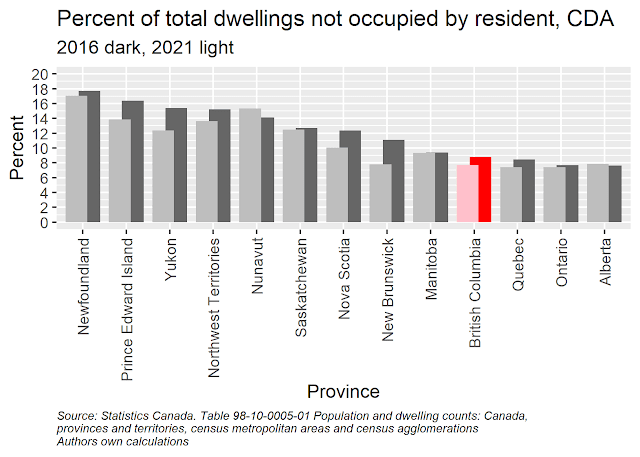
   

    Thus, while about 8% of homes were vacant in 2021, we see that BC really is on the bottom end of this distribution, Newfoundland actually having the highest proportion of vacant homes (but not necessarily the highest shelter and rental costs!)

    If we magnify the view from the national/provincial level to evaluate the percentage of vacant homes by Census Metropolitan Area (Essentially cities, and greater cities, IE Greater Victoria). we see much of the same. The regions with some of the highest rents and real-estate prices, Vancouver and Victoria are both significantly below the BC average at just under 6% of homes being vacant in 2021. 

   
    Again; what if we focus the view a bit more, just looking at the municipalities that make up the Capital Regional District (CRD). Here again, we see that, on average, about 1 in 20 dwellings are sitting vacant (just over 5% in 2021). 

    Now, I want to bring attention to Langford, as this is an area that has witnessed an explosion in the construction of new units over the last several years. What we see is that (despite fears and stories) the vast majority of these dwellings are occupied by a usual resident, such that the percent vacant is lower than the regional average. 


    Thus evaluating this, it appears that the boogeyman of vacant homes drastically driving up prices is just like the real boogeyman - a figment of our imagination. Keep in mind, I am not saying that vacant homes do not impact prices, having 1 in 20 or 1 in 10 dwellings vacant is not ideal socially, and having 5-10% of homes being purchased strictly for capital gains investment is a problem that needs an effective policy to address. 
    
    Instead, what I am saying is that these vacant dwellings do not seem to be a primary contributor to the cost of housing/rent -- if they were we would expect to see high percentages of vacant units in areas with high purchase prices and rent while seeing more reasonable prices in areas with low percentages of vacant units. 

    Thus - If we can't point our finger and vacant homes - what is to blame for the sky-rocketing prices and rents? Again, this appears to be a simple supply and demand problem - for years we have underbuilt, and engaged in restrictive zoning. these practices allowed for the rate of population growth and household formation to exceed the rate of new dwelling construction, the fact of the matter is we have years of excess demand to construct before we even begin to solve the problem. 

    To put this problem in the terms of a simple metaphor - suppose that we have a kitchen sink. The water flowing into the sink is the population growth, the people who need to be housed. A cup is a dwelling. In this case, the tap is left on - there is no (ethical) way to turn off the flow of water. 

    For years, we ignored the problem, occasionally filling up cups with water, but generally allowing the tap to fill up the sink (excess demand). Today, we are at a point where the water is about to crest the sink and begin to spill out onto the floor. The solution? we need to start filling up more cups of water to move the water from the tap and sink into cups (dwellings). 
    
    I encourage you to undertake this experiment - at the point when the water is about to crest, it will seem crazy - you will be filling up cups rapidly and it will look like A LOT is being done -- however, there is so much pent up demand in the sink, that despite all your work (and having cups everywhere) you will still be dealing with the excess demand (pool in the sink) for a long time before you can return to addressing the water coming from the tap. 

    In reference to the vacant homes - yes it is annoying that 1 in 20 cups are being held by someone else and they are refusing to allow you to use them to empty the sink - but this was not what caused the problem - it is only an annoyance - the problem was caused by years of letting the tap run without filling up cups.

    What are your thoughts? Feel free to comment below. 


Tuesday, 2 July 2019

"Housing Should be Affordable"


This is an interesting opinion piece from the CEO of the Canadian Mortgage and Corporation (CHMC)

As the title sums up, housing should be affordable.

Clearly a normative statement, but just the same, there is definitely a general social belief that everyone ought to be able to afford or have access to shelter. The question then is what should the price of shelter be?

As any first-year Econ student can show, the price of a good will be determined through its supply and demand. As Mr.Siddal outlines in his article, over the last several years demand for housing has gradually increased due to factors such as population growth, speculation, access to cheap credit, etc. while supply has remained relatively constant due to restrictive zoning.

Mr. Siddal discusses many of the current initiatives to ease affordability and rightfully critiques many of them stating that they simply further encourage demand by allowing greater access to the market.

Despite this rising demand pushing up prices, the supply has maintained relatively constant (unlike the picture above, that is, vertical in the short-run). This has simply resulted in inflating prices creating one of the greatest creations of wealth in generations (For the generations who were already owners).

I recently had a very good question in regards to this from a student who stated (Paraphrased).
House production appears to be perfectly competitive, or nearly so. There are many builders. Despite differentiated housing, many are at the point where they will accept any shelter - thus the consumer views the good as fairly homogenous (same). Shouldn't this price increase cause enourmous positive profits to builders and developers causing more to enter, increasing supply and bringing the price back down to a zero profit level?
While I tend to agree with the statement, there are some serious issues to this. It is primarily (at least here in coastal BC) the land, not necessarily the buildings which have increased in price - Can't supply more land. Thus the solution would be:

  1. More Sprawl - frowned upon with increasing traffic congestion, gas prices and known environmental/health impacts. 
  2. Densification - more units per space of land, thus keeping the cost per unit down. 
While densification seems like a great solution, it runs into many hurdles such as zoning restrictions and existing residents opposing any development due to the potential of "Changing the nature of the neighborhood". Thus at the municipal level, densification and revision of zoning bylaws have been a large barrier preventing new developments and thus preventing an increased supply of shelter. 

What should be done then? 

This is clearly a difficult question. As Mr.Siddal states, housing should be affordable. The problem with this statement, however, is "at what price is housing affordable?" how do we determine what this price is? and even if we do determine some price, what makes that price affordable? 

Let's assume for a second that we do (somehow) known what an affordable price is. How do we go about achieving such a price?

Restrict Demand? Doing so would cause the demand to shift left, lowering the price. But how does one go about restricting the demand for housing? Furthermore, if you restrict demand by placing tougher stress tests on qualifications, or placing higher taxes on property transfers ... doesn't this in fact just inhibit affordability? 

What if we just restrict demand to limit "Speculators". This is what we are seeing right now in the most populous parts of BC with the "Speculation tax". If you follow the news, this is very unpopular amongst many people with comments typically being along these lines:
  • We have had a family vacation home in [city] for generations, now I have to pay an extra [$tax] in order to keep this. We spend [X weeks] in this community every year contributing to the local economy, now we won't be! 
  • I bought a home in [city] as part of my retirement plan. now with this extra [$tax], I won't be able to afford to retire.
That is, families and individuals who are owning second properties for recreation or investment have been labeled as speculators. I have written about this previously, commenting that this should be a vacant homes tax, not a speculation tax - thus being clear that it is to encourage the use of housing as shelter, not simply as a tax on speculation. But just the same the imposition of this tax has alienated a generation who could afford more than one residence and had done so for either recreation or retirement planning purposes. 

Restriction of demand then seems to be politically unpopular amongst those restricted (we will see how it pans out with voters). 

This then leaves expansion of supply? Causing a shift of the supply curve to the right, which would similarly cause a reduction of price. 

How do we go about this? A few ideas are offered such as:
  • Easing of zoning bylaws to encourage more development.
    • Will fundamentally 'Change the nature' of neighborhoods which has proven to be unpopular with existing residents (NIMBY)
  • Engage in a large publically funded and owned building strategy.
    • This kicks up many more questions such as "where?" again NIMBY. As well as brings up many memories of "The Projects" amongst many other public housing developments. 
That is the problem with increasing supply seems to be that there is not the will to have this happen. It is a great idea, as long as it happens somewhere else. Hence the problem. 

Suppose we overcome the NIMBYism (some evidence that some municipal governments are making progress on this) which stimulates an increase in supply and allows prices to come down. This leads to a second question which is one many don't actually want to ask. "Do we want housing to be affordable" That is, do we want prices to fall to a point such that people can afford shelter?

A recent report (news article here) highlighted that current prices would need to be cut in half for millennials to be able to afford to buy. 

Thus, if we want affordability (let's assume this definition of affordability for a minute) do we actually want prices to fall by 50%?

Given many factors, the answer to this is likely no. Many Canadians who own their house have used their home as their primary investment vehicle for retirement. This now throws the retirement of many into jeopardy. 

Similarly, if we look at the household indebtedness of Canadians we find it is quite high with a big proportion of this being mortgage debt. For these Canadians, a severe price increase would put them in a precarious, if not negative equity situation. Similarly, a big problem impacting the wealth and equity of a large swath of Canadians. 

To conclude. Yes, few would argue with the statement that housing should be affordable. the issue with this, however, is that any action to make housing affordable is politically unpopular as the result is the erosion of wealth and equity from current owners in order to allow sustained entry to future owners. 

The real solution, if possible, would be some solution that does not result in a zero-sum outcome. That is a solution which allows current owners to maintain their equity while allowing new entrants affordable options. 

What are your thoughts? feel free to comment below.


Thursday, 5 April 2018

Speculation tax push back.

Source: http://www.oecd.org/social/affordable-housing-database.htm
Since the proposed speculation tax in the 2018 BC budget, the news has blown up with opinion pieces and articles in opposition to this tax. some examples can be found here and here, although there are many more.

Predominately it seems that the majority of the outrage comes down to a misunderstanding of the tax due to a poor choice of naming. That is, the outraged cry is usually along the lines of
"I am not a speculator, I just have a home in Saanich which I only live in a few months in the summer because I love the area" 
True, these individuals are not speculating, but the problem still remains, they own a piece of capital (housing stock) which they are choosing to allow to sit idle while so many individuals in the region are unable to find housing, let alone affordable housing.

Thus the trouble is in the name, this should not be labelled as a speculation tax but rather a vacant homes tax. In this way, we get around the problem that keeps arising from people feeling as if they are being labelled as a speculator while addressing the real problem of an idle capital stock.

The recent article listed above (first hyperlink) by the Times Colonist claims that the new tax will be a job killer as it will depress the housing market due to the fact that people will no longer be buying properties (to sit vacant for the majority of the year).

True, if this tax successfully decreases the housing market - this will hurt the BC economy in the short-run. Currently, the FIRE (Finance, Insurance, Real Estate) industry accounts for about 25% of BCs GDP  (23% in 2012, 24% in 2016), making it the largest contributor to BCs economy by far. That is, if this tax successfully pushes down housing prices, it will ripple through the entire FIRE industry, pushing down BC's GDP, pushing up unemployment (all else equal in the short-run).

Does this then mean its a bad thing? Well yes... but.

The alternative is we do nothing, we allow capital to continue to sit idle, allow housing prices to continue to inflate exponentially faster than wages until we arrive at such a discrepancy (currently being seen in Toronto, Vancouver, etc.) that professionals can no longer afford to live in these municipalities, which similarly hurts jobs as there is no labour to be had. (herehere).

Along these lines talking to several HR professionals in the CRD I am continually hearing the same story that the only applicants they receive are either (A) from established (older, near retirement) Victora applicants or (B) from Vancouver (higher priced market). Any time a qualified applicant is offered a job outside of these two areas the applicant resultingly turns down the offer due to lack of housing.

If labour refuses to move here for jobs then employers have two options. They can either (A) begin to offer higher salaries (which would help offset the cost of living) or (B), if possible, they will relocate to other areas which jointly offer lower wages as well as cheaper land, thus jointly decreasing two costs of production.

So yes, this tax does stand to hurt us today - the alternative is prolonged hardship and a flow of labour out of the region, similarily contracting the economy in the future.

What are your thoughts on the new speculation (vacant homes) tax? will the benefits of this tax outweigh the costs or will the distortionary effects of a tax create more harm than good? feel free to comment below.


Saturday, 24 February 2018

BC Budget - Housing

Source: https://www.facebook.com/homeiswhereitstarts/

As expected one of the big highlights of the recent BC Budget (yet to be passed in the legislature) is the focus on implementing new policies in order to deal with the housing affordability issues we have seen in BC over the last decade.

The full BC Budget can be found here, the highlights here, and finally the focus on the housing action plan here.

First some praises for the plan.

The plan, although not perfect, aims to deal with both demand and supply side problems currently being faced by the real-estate market. With these policies being aimed to cool demand and stimulate supply (Contrast this to previous policies such as 0% downpayment loans to help first time home buyers. A policy which further stimulated demand).

On the Demand side:

  • Introduction of a speculation tax.
  • Increasing the foreign buyers' tax from 15% to 20% and expanding this tax out of Metro Vancouver to include the Fraser Valley, CRD, and Okanagan.
  • Increasing property taxes (school tax rate) for properties over $3 million. 
  • Actions to prevent speculation and pre-sale condo re-assignments. 
On the Supply Side:
  • Government $6 billion dollar investment in affordable housing
    • 14,000 rental units for 'middle' working families.
    • increasing student residences at universities and colleges.
    • Providing changes to property taxes to encourage rentals. 
What does all this mean? Let's start working on the demand side followed by the supply. 

First the speculation tax, other than the announcement of the idea of a speculation tax, we know very little as to what this would entail, as a result, it is difficult to say what effect this may actually have on the market. Just the same, I am under the belief (normatively) that if effectively placed could have a significant impact on cooling the market. I have written several times on the role of speculation in the housing market, starting with this article here.

Second the Foreign Buyers Tax. I have written about this before as well. to be brief - I am not a fan of this policy. To read my reasons why you can find the previous post here.

Increasing property transfer taxes and school rate taxes for properties over $3 million: There is a part of this policy which seems satisfying. Ratchet up the taxes for those rich enough to afford a $3 million mansion, but keep in mind, many of the people who have found themselves owning multi-million dollar properties are seniors, on fixed incomes who have just always lived in their house and seen property values rise exponentially around them! 

I have witnessed several sad experiences where seniors have come into the bank, they had bought their property decades ago, out in the boonies, only to find that now their property has exploded in value, with the property taxes being so high that they can no longer afford to pay them through any method other than a reverse mortgage, or city lien on their property. 

Finally, actions to prevent speculative pre-sale re-assignments of condos. Again my belief is that this could be an effective policy, as with the speculation tax, however, the big question I have is what does this look like and how will it be enforced. 

To the supply side: 

A $6 billion dollar investment over the next ten years. Let me start by saying that a minority government releasing a spending plan over the next ten years is rather wishful and thus leaves me skeptical. 

I am not sure of the exact details or conditions of this $6 billion, so let's assume this money is available as financing, and funding for public institutions to increase rental housing and student residences. 

First, building 14,000 rental units for the 'middle'. This may be a great idea, but ultimately I feel it will fall into the slow molasses of municipality zoning and bylaw processes which many have argued to be the primary supply problem contributing to the current affordability crunch. Thus I am interested to see how this materializes.

If this does materialize and if this materializes as 14,000 new rental units, not just "14,000 rental units over the next 10 years" then this may have an effect of driving down rents in areas like the CRD and Metro Vancouver where rental affordability remains just as much of an issue as purchasing a home (near 0% vacancy rates in both regions). 

An increase in investment for student housing will also help to relieve the pressure on rental markets (again primarily in university towns such as Nanaimo, CRD, Lower Mainland and the Okanagan) by allowing students their own specific residence it frees up more rental units for the rest of the population, thus allowing an increasing vacancy rate and decreasing price pressure for rents. 

In conclusion, there are still a lot of unknowns with this housing action plan, but preliminary evaluation looks promising to slow (or temporarily) reverse the acceleration of home and rental prices through policies aimed at cooling the demand while stimulating the supply. 

In the coming weeks, I am sure the specifics of these policies will be revealed. Given the nature of politics, come that time I may have to retract the optimistic tone I have. 

What are your thoughts on this policy?  I have taken a rather one-sided approach in my discussion above, but all policies are going to have both winners and losers. Think about who the losers are following the imposition of these policies and what this means for them. 

Feel free to comment below. 

Tuesday, 14 March 2017

Calls for extending the foreign home buyer tax

Image source: http://vancouver.ca/about-vancouver.aspx
If you have been watching the news, there have been recent calls to extend the Vancouver foreign home buyer tax (a 15% tax levied on foreign buyers of real-estate) from Vancouver to Toronto and Victoria as well.

some of these news articles can be found here, here, and here.

What I find amazing about these arguments for a foreign homebuyer tax is the covert racism that underpins it. That somehow, only foreigners are able to afford homes in such quantities that it stimulates demand and pushes up prices!

Specifically, (in my opinion at least) the problem is not foreigners willing to pay obscene amounts for homes - if they plan to reside in said homes. Rather, the problem becomes when individuals (whether domestic or foreign) are willing to pay obscene amounts for these homes because they view these as an investment rather than a form of shelter.

Let's compare and contrast two similar and current situations.

First, Imagine if you will, an individual from China decides to move to Vancouver and purchased a  $1 million dollar condo to live in, paying a $150,000 tax because they are not a Canadian citizen or permanent resident. However, this individual has planned to live in this home - maybe attending school, working, or starting their own business, all in Canada and contributing to local economy.

Meanwhile to contrast.

Second, a Canadian investor from elsewhere in Canada buys a condo in Vancouver for $1 million. Because this investor is domestic, he (she) pays no foreign homebuyer tax. At the same time, this investor is not residing in the condo, nor are they renting it out, as they are betting on the market appreciating and earning capital gains through this price appreciation.

What is the difference between these two cases?

In both cases, there was a new purchase of real-estate, adding to the demand for real estate in Vancouver.

the difference rests in what is done with that purchased real-estate.

In the first case, the foreign national has purchased the condo to live in, using it as shelter, thus jointly adding to the local economy, spending their money and spurring economic activity. (even if they are also hoping to sell in a few years for capital gains!).

In the second case, the domestic investor has purchased the condo to sit empty. thus adding to the demand for real-estate, but other than the initial contribution to the FIRE (Finance, Insurance, Real Estate) industry, there is no prolonged contribution to the local economy.

The question then - which scenario is more damaging?

Well, if real estate is viewed as just another good, then neither case is overly damaging, as in both cases both the buyer and seller are obtaining value from their transaction - which is why they transact!

However, if real estate is understood to be the primary form of shelter (a basic human need) then the second case clearly carries more social costs (increased demand pushing up the price while excluding others the use of the shelter.).

While the first case also adds to the demand, pushing up the price and excluding others the use of the shelter - we are also experiencing a continued contribution to our economy, through an addition to the labour force, additional consumer spending, and possibly investment, all of which helps spur the economy which may not happen in the pure real estate investment situation.

To wrap up, my personal feeling, and opinion. Is that there is a problem with the current real estate market, but that foreign buyers are not in themselves the problem, but rather an easy target. The problem lies in the use of real estate as an investment - something to be bought to earn a return rather than something to be used as a shelter. In this case, it is not that foreigners are the problem, but real estate investors in general, whether they be domestic or foreign.

Thus a foreign homebuyer tax is discriminatory, and perhaps even violates trade agreements which require laws to be enacted fairly over both domestic and foreign individuals and companies. Specifically, what should be evaluated is a changing tax structure to penalize real estate speculation in general, regardless of ethnicity - however, this is clearly easier said than done!

What are your thoughts on this? feel free to comment below.

EDIT: I want to clarify, real-estate investment in terms of a rental property is not really an issue in my mind and in fact should probably be encouraged. The issue becomes real estate investment in vacant properties for capital gains and given the recent census and many investigative news pieces, this appears to be a growing problem.

Tuesday, 28 February 2017

Present Value of shelter -- part 2

Image Source: https://clipartfest.com/download/c4caaa1fc43167db76f3e9cf0206708647023d40.html

Here is part two of a post that aims to evaluate housing as an investment ... where owners are expecting to earn an annual return (rent) as well as capital gains due to appreciating property values upon final sale.

in part 1 - I laid the groundwork as to the basic premise which would be used to evaluate the prices of real-estate.

recall -- that basically, the most a rational investor would be willing to pay for an investment is the present value of the income stream of the investment, with all future income being discounted by a corresponding equivalently risked market return. for a re-hash as to what this looks like, part 1 can be found here.

In this, we have to lay some basic assumptions out first.

  • housing in Victoria, BC (the CRD) has had an average growth rate of 5.07% per year from 2005 to 2016 based on the Canadian Real Estate Associations Housing Price Index (CREA HPI) which can be found here.
    • (For those familiar with the rule of 72 -- this estimates that if this continues, the price of housing will double approximately every 14.2 years.
  • Rent prices between 2015 and 2016 in the CRD increased on average by 5.77% although this does differ from a min of 4.9% for a 1 bedroom and up to a 6.8% increase for a 3+ bedroom, as determined by CMHC which can be found here
    • Recognizing that between 2015 and 2016 there was an influx of people into the CRD pushing up prices, coupled with not being able to have access to a longer time frame of rental prices, I have arbitrarily adjusted the annual growth rate of rental prices down to 4.5% from 5.77% as I feel this 5.77% is not representative of normal rental activity.
    • Second, BC tenancy act allows landlords to increase rent at 2% above inflation ... given a targeted inflation rate of 2%, this further seems to fit this assumption
  • For reference: Expected return over the last 61 years from an aggressive to a conservative portfolio is as follows: data obtained from here.
    • Aggressive portfolio (80% equity, 20% bond): 10.9% per year.
    • Moderate portfolio (60% equity, 40% bond): 9.8% per year.
    • Conservative portfolio (20% equity, 80% bond): 8.11% per year.
Recall we want to compare our payments from this investment in real-estate versus an equivalently risked investment -- Based on a preliminary search, the consensus seems to be that real-estate is less risky than equities, but riskier than bonds (due to potential maintenance problems, non-payment, periods of vacancy etc.). Thus perhaps around 9% similar to our Moderate portfolio may be good grounds to compare real-estate to (we will, in fact, calculate for an array of interest rates).

Presently we have the following price and rental situation in greater Victoria (CRD):

If we (as investors) were to assume that our annual house price was to continue to increase at 5.07% per year and that our annualized rental payment could be expected in to increase at 4% per year into the for seeable future, then we should expect the following present values if we hold on to the property for 30 years, collecting rent, and then willing to sell it for its market price.

Where if we sum up the present value of the future income streams over 30 years (discounting by the respective interest rates) we see that at the current market price -- If the interest rate is 7% then all real-estate regardless of unit type is a great buy! alternatively, as we move up to an 8% interest rate, one bedroom and three plus bedroom units are over priced. Finally, as we move up to a 9% interest rate, all units are over priced.  

Now perhaps investors are not actually looking to purchase real estate to invest in for a 30 year time period, so perhaps that is too long to consider. Thus, let's graphically look at the present value of each unit based off of its income streams over a 0,1,5,10,15,20,25 and 30 year time period. keep in mind that over a time period of zero, we have the current price of the unit. 

As this would be a bit too cumbersome to display in tables, we have graphs:

Updated: As was kindly pointed out to me, the previous graphs in this post were very misleading - the nature of a line graph seemed to show how the price of real-estate was expected to change over the next 30 years when this was not the case. the graph instead is demonstrating what the present value of real-estate is based on the period of time you hold it for as an investment.


At a 7% prevailing interest rate, all unit types are currently for sale for cheaper than their present value for all holding period.

As we move to an 8% prevailing rate, three or more bedrooms and one bedroom units initially have higher present values (for short holding periods) but quickly decrease.

 Finally, as we look at a 9% prevailing rate, we see rapidly falling present values for all holding periods greater than 1 year -- indicating that all unit types would be overpriced relative to their present value of future income.

As stated at the beginning, real estate as a risk class is considered less risky than equities, but riskier than bonds -- I arbitrarily assumed a rate of 9% based off of historical portfolio returns. It shouldn't however, be a surprise to learn that in recent years we have been in a lower interest rate environment, thus it is under this rationale that I have included a range of prevailing rates. To finish off, for reference, I will include one lower rate of 6% and the corresponding present values.


The takeaway? depending on our view of the prevailing interest rate on a similarly risky investment, current real-estate in the CRD could continue to increase, or could already be over-priced.

Of course -- all of this is extremely sensitive to our assumptions - especially the growth of real-estate and rental prices into the future ... if either of these begins to slow, then we have a very different story!

What are your thoughts -- should real estate be viewed as an investment? or strictly as a means to provide shelter? Feel free to comment below.


Thank you to Francis and Joel for your comments leading to this revision!


Thursday, 9 February 2017

Unoccupied houses

In a past post, I made a statement that when looking at household formations and the rate of new households being built it seemed that supply was outpacing demand, thus we should expect to see falling prices. Clearly, we are seeing the opposite with home prices.

I speculated that this may be due to investors purchasing houses for speculative capital gains, leaving them vacant. At the time this was pure speculation - then today I began noticing a number of news articles on the subject pulling data from the latest census.

it appears my speculations was not entirely wrong!

You can read my previous post here. Or view some of the related news articles here and here.

Keep in mind -- real-estate investing is not a bad thing. If those investments are being rented out to provide shelter, then shelter is still being provided. It is only when the price is being pushed up and shelter is being denied when we potentially have negative consequences and overall falling affordability for both owners and renters.

Keith

The Langford Budget: There are No Solutions, Only Trade-offs

  Image Generated with Google Gemini I don’t often shift to this perspective on this blog, but today I am putting on my hat as a Langford Ci...